Mass Scale
A 3-D printed digital scale built around a strain-gauge load cell, an HX711 amplifier and an Arduino Nano, read over serial for data logging. Three generations in one repository: Benjamin Hubbard’s 2019 OS Nano Balance, the lab-grade scale Michigan Tech’s MOST lab published in Instruments in 2020, and the FAST research group’s 2025-26 revival, which is the current design.



Overview
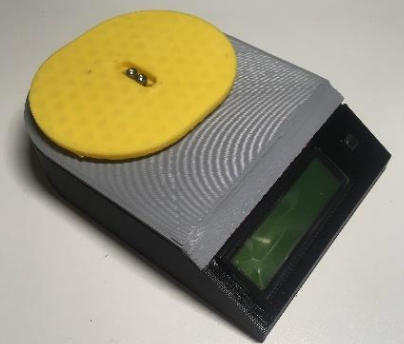
Section titled “Overview”The scale is a printed housing that holds a single-point parallel-beam load cell (a TAL220 for kilogram ranges or a TAL221 for gram ranges), an HX711 24-bit load-cell amplifier, an Arduino Nano, a push-button, and optionally a 16 x 2 LCD. Everything runs from 5 V over USB, so a phone charger or a computer’s USB port powers it. The button tares the scale; over serial, a computer reads it continuously and calibrates it against a known mass.
The current design is the revival’s:
cad/openscad/– the OpenSCAD v2 enclosure, with a bevelled front face for the LCD, and the platter that fits over it. Parametric: the dimensions are variables at the top ofassembly.scad.cad/openscad-v3/is the next revision, in progress, with a sliding, latching lid.firmware/mass-scale/– the rewritten firmware: calibration over serial, stored in EEPROM; tare from the button or serial; a readout of raw and calibrated values on a 100 ms timer, each cycle averaging three HX711 reads, so about 3 Hz at the 10 samples per second HX711 modules default to; guards against a missing amplifier or a corrupt calibration. Calibration holds up the readout and the button until it finishes or is aborted.
The 2020 design and firmware are kept in full and still checked, and the 2019
files are kept for reference and attribution; see History and
docs/sources.md.
The scale is described in:
Hubbard BR, Pearce JM (2020). Open-Source Digitally Replicable Lab-Grade Scales. Instruments 4(3): 18. doi:10.3390/instruments4030018
The paper tests three load cells, a 5 kg TAL220 and 500 g and 100 g TAL221s, against two commercial laboratory balances and against standard masses. It reports repeatability within 0.05 g for all three, down to a standard deviation of about 0.005 g for the 100 g cell, readings that track the laboratory balances linearly, and a parts cost of about USD 51 without an LCD or USD 66 with one (USD 41 and 47 counting only the parts used out of bulk packs), against USD 110 to 289 for commercial scales with a serial interface.
Status. The v2 enclosure and platter have been printed, and the firmware builds and has had its calibration and readout reworked since; neither has been characterised the way the paper characterised the 2020 scale. The v2 parts do not yet model the load cell’s mounting or the electronics’ seats, and v3 is unfinished; the firmware does not yet have the 2020 firmware’s SMA protocol, OLED support or averaging filter. See Known problems and the issues.
Documentation
Section titled “Documentation”History says which folders hold each generation. Each top-level folder has a README:
cad/– the printed parts of every generation, with the published 2020 STLsfirmware/– the current, 2020 and 2019 firmware, and the wiringelectronics/– the 2020 Fritzing circuit and its breadboard and schematic viewsbom/– the paper’s bill of materials, as tables
docs/ has the 2020 operation guide, the
breadboard assembly guide,
the paper, the
datasheets, the
test data, the
serial protocol notes, and
sources for everything else. tools/ holds the STL and
FreeCAD comparison scripts the checks use.
Getting started
Section titled “Getting started”You need OpenSCAD,
arduino-cli, Python 3, curl,
unzip and just. FreeCAD 0.18 or later
opens the 2020 and 2019 CAD; it is not needed for the checks.
just firmware-deps # install the pinned AVR core and libraries; fetch the pinned HX711 and LiquidCrystaljust check # check the FreeCAD files and STLs, render every OpenSCAD part, build every firmware target (what CI runs)just render # write every OpenSCAD part to build/cad/openscad/just firmware # build every firmware target and leave the .hex files under build/firmware/OPENSCAD names the OpenSCAD command when it is not on PATH, and
OPENSCAD_FLAGS adds flags to every render.
To build one: render enclosure and platter from cad/openscad/
(just render, or the customizer in OpenSCAD’s GUI with assembly.scad), buy the
parts in
bom/ (the
electronics are the same in every generation), wire them as in
firmware/README.md
or the breadboard guide, and flash the firmware:
just firmwarearduino-cli upload --fqbn arduino:avr:nano -p /dev/ttyUSB0 --input-dir build/firmware/mass-scaleThen open a serial monitor at 115200 baud (newline line endings). The scale
tares itself at start-up and prints Raw: <counts>, Mass: <grams> g; t or the
button tares it, and c, u00 with the platter empty, then a<grams> with a
known mass on it, calibrates it and stores the result in EEPROM. Any serial
client that logs, such as PuTTY, records the readings.
firmware/mass-scale/README.md
has the details; docs/operation.md describes the 2020
firmware and its SCP-0499 commands.
Known problems
Section titled “Known problems”Carried over from the published designs, or opened by the revival, and not fixed here; each is an issue:
- Drift after power-on. The paper observes that the reading drifts noticeably when the scale is first switched on, largely with temperature, and recommends a warm-up; no firmware here compensates for temperature.
- The current firmware lacks features of the 2020 firmware: the SMA SCP-0499 serial protocol, the OLED display driver, the configurable averaging filter, and the library form that other sketches can use.
- The v2 enclosure has no load-cell mount or electronics seats, and v3 is unfinished; the 2020 FreeCAD design has both.
- The OLED display is unstable on small boards (2020 library). Upstream’s
README says an OLED needs more RAM than a Nano has (use a Nano Every or a
Mega), and that turning an OLED off and straight back on with
XLcan stall the firmware. - The housing is light. The paper notes that the printed housing would deform under heavy loads, which side-loads the load cell; higher-capacity cells want a stiffer housing.
- The published 2020
Base.stlpredates the FreeCAD document. It is 1.25 % smaller than the base the document builds, with the same outline; the other three STLs match the document (seecad/README.md). - The paper’s sketch was Windows-only as published: its includes used
backslashes, fixed here;
CHANGELOG.mdlists the import fixes. The 2019 sketch is kept as published and is not built: it includes its libraries at the submodule paths of its own repository, with backslashes. - Third-party datasheets are redistributed without a licence statement; see
LICENSING.md.
History
Section titled “History”The repository carries all three histories, joined without rewriting any of them. An annotated tag marks each source as it was:
| Generation | What | Tags |
|---|---|---|
| 2019, OS Nano Balance, Benjamin Hubbard | The first version: an Arduino Nano, an HX711 and a TAL220 or TAL221 in printed parts drawn first in OpenSCAD and then in FreeCAD, with a sketch that calibrates from a button against a fixed mass. Published at brhubbar/OS_Nano_Balance and on Appropedia as 3D printed digital balance. Here: firmware/os-nano-balance-2019/, cad/freecad-2019/, cad/openscad-2019/ |
mtu-nanobalance-2019 |
| 2020, the MOST lab-grade scale, Benjamin Hubbard and Joshua Pearce | The scale the paper describes: one parametric FreeCAD document, the DigitalMassBalance 2.0.1 sketch implementing the SMA SCP-0499 serial protocol, and its later library form MOST_MassBalance 3.4.0. Published in Instruments, on OSF me9a8, at gitlab.com/mtu-most/most_massbalance and on Appropedia. Here: cad/freecad-2020/, firmware/most-massbalance-2020/, electronics/, bom/, docs/ |
mtu-instruments-2020 (the firmware as published with the paper), mtu-final-2021 (upstream’s last commit), mtu-osf-2020 (the OSF files as published), and upstream’s own v3.0.0 to v3.4.0 |
| 2025-26, the FAST revival, Cameron Brooks | A new OpenSCAD enclosure and platter (v2), a next revision in progress (v3) using the load-cell-scad library, and a rewrite of the 2019 firmware with calibration over serial. Published at uwo-fast/mass-scale, which this repository continues. Here: cad/openscad/, cad/openscad-v3/, cad/openscad-v1/, firmware/mass-scale/ |
fast-revival-2026 |
CHANGELOG.md
lists what changed when the histories were joined and when the 2020 files were
imported; docs/sources.md says where every file came from
and what was left out.
Citation
Section titled “Citation”If you use this scale, please cite the paper above. GitHub’s Cite this
repository button gives it, from
CITATION.cff,
which also references the 2019 and revival work.
License
Section titled “License”This repository is licensed by component: the current firmware and the 2019 and
2020 firmware and design files are GPL-3.0-or-later; the revival’s OpenSCAD
designs are GPL-3.0-or-later and CERN-OHL-S-2.0, at your option; the bundled
libraries are MIT and LGPL-2.1-or-later and the vendored load-cell-scad
GPL-3.0; the paper and the guides adapted from it are CC-BY-4.0, the
Appropedia material CC-BY-SA-4.0, and the datasheets state none.
LICENSING.md
states what applies where, including the questions still open.
Contact
Section titled “Contact”Maintained by the FAST research group. For research collaboration inquiries, contact Dr. Joshua Pearce (joshua.pearce@uwo.ca).