
UV Curing Box
A modular UV curing box for post-curing SLA-printed parts. It is built from identical square LED boards, joined edge to edge by 3D-printed brackets.
It was designed for the open source nasopharyngeal swab (uwo-fast/nasopharyngeal-swab), whose resin swab heads it cures, and it was published with the swab in Gallup et al. (2020), below. This repository holds its design files, split out of the swab repository with their history.
Contents
Section titled “Contents”elec/: the LED board
Section titled “elec/: the LED board”A KiCad 5 project (UV_Curing_Box.pro, .sch, .kicad_pcb, made with
pcbnew 5.1.5) and its fabrication output in elec/Gerbers/.
- A two-layer board, 80 x 80 mm.
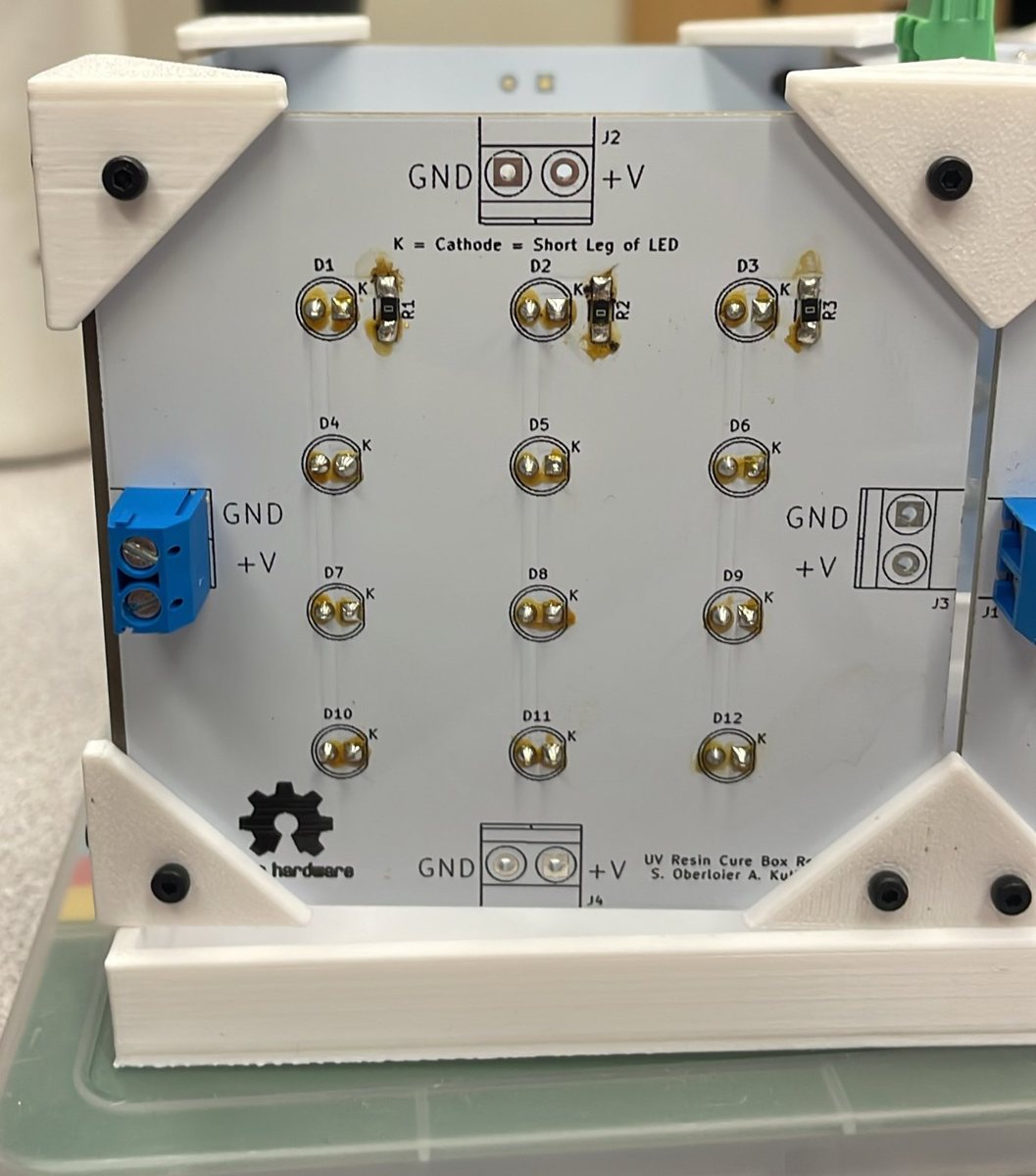
- 12 LEDs in 5 mm through-hole footprints, as three strings of four from +12 V to ground, each string with one series resistor in a 1206 footprint.
- 4 two-pole terminal blocks (Phoenix MKDS 1.5), all in parallel across +12 V and ground, so power can come in on one and go on to the next board.
- 4 M2 mounting holes, 2.2 mm, each 5 mm in from a corner, where the brackets attach.
The schematic leaves the parts’ values unset: the LEDs are LED_g and the
resistors 0. The paper uses 395 nm UV LEDs and twelve boards, and gives the
whole curing system’s cost as $45.42.
The symbols and footprints come from a library, OCI_UPL, that is not in this
repository. The board file carries its own footprints and UV_Curing_Box-cache.lib
carries the schematic symbols, so both open without it.
The Gerbers are dated 2019-08-26 and were exported by a KiCad 6.0 development build.
mech/: the brackets and swab holder
Section titled “mech/: the brackets and swab holder”brackets.scad is the OpenSCAD source for the brackets that join boards through
their mounting holes. Opened on its own it renders e_2x2(). Three of the STLs are
its modules, rendered at a finer resolution than the file’s $fn = 30:
| STL | Module | What it joins | Size (mm) |
|---|---|---|---|
plate.stl |
p_2x2() |
four boards meeting at their corners in one plane | 20.2 x 20.2 x 2 |
edge.stl |
e_2x2() |
four boards along an edge of the box, two on each face | 20.2 x 13.7 x 13.7 |
corner.stl |
corner() |
three boards at a corner of the box | 13.7 x 13.7 x 13.7 |
legs.stl (4 x 4.7 x 95 mm) and top.stl (74 x 50 x 2.5 mm) are the swab holder: four legs
and a top the swabs hang from. They have no source here.
The paper (sections 5 and 6.1) builds a 4 x 8 x 8 in box from 12 boards. Size a box in whole boards, then count the parts from it.
What the paper’s box takes:
| Part | Quantity |
|---|---|
LED board (from elec/Gerbers/) |
12 |
Through-hole UV LED, 395 nm (the footprint is LED-5MM) |
12 per board |
| 2-pole screw terminal block | up to 4 per board |
Edge bracket (edge.stl) |
12 |
Corner bracket (corner.stl) |
8 |
Plate bracket (plate.stl) |
2 |
| M2 x 10 mm screw | 48 |
| 12 V DC, 5 A power supply, and an IEC power cord | 1 |
| 18 AWG wire | 1 m |
The paper’s bill of materials lists the screws as M3, which is an error: the board’s
mounting holes are 2.2 mm (an M2 footprint) and the brackets’ are 2.1 mm (h_d in
brackets.scad), sized for M2.
- Lay the boards out unfolded, as the box opens flat, and decide which terminal blocks to fit so every board gets power at least once. Not every board needs all four.
- Solder the LEDs on the side opposite the silkscreen, so they face into the box. LEDs are polarised. The paper runs them at full intensity: the resistor pads take a 0 ohm resistor, or a bridge cut from an LED lead.
- Join the terminal blocks of boards that sit edge to edge in one plane with short
lengths of clipped lead, clamped in both blocks. The blocks’ polarity differs, and
the board does not mark it: pin 1 is +12 V on J1 and J4 but ground on J2 and J3
(
elec/UV_Curing_Box.net). Check which pin is which before linking two blocks or wiring the supply. - Screw the boards together with the brackets: plate where four boards meet in one plane, edge along an edge, corner at a corner. The paper threads the screws into the plastic from inside the box, with no nuts.
- Wire the corner joints with insulated wire. Left long, these wires double as the lid’s hinge.
- Wire one terminal block to the supply’s + and - terminals, and the IEC cord to its mains terminals. Check the cord’s colour code before connecting it.
- Before powering it, measure the box’s input resistance. Around 5 ohm or less suggests a short.
Hang the swabs tip-down from the holder printed from legs.stl and top.stl,
set it in the box, close the lid and power the box. The paper cures swabs for 45 min.
Lab rebuild
Section titled “Lab rebuild”The printed brackets in mech/ fit the boards poorly, so the lab’s working box
was rebuilt with connectors from
panel-cube-joints, a
separate parametric library. Its example examples/example_two_cube_box.scad
lays out every part of this box to print.
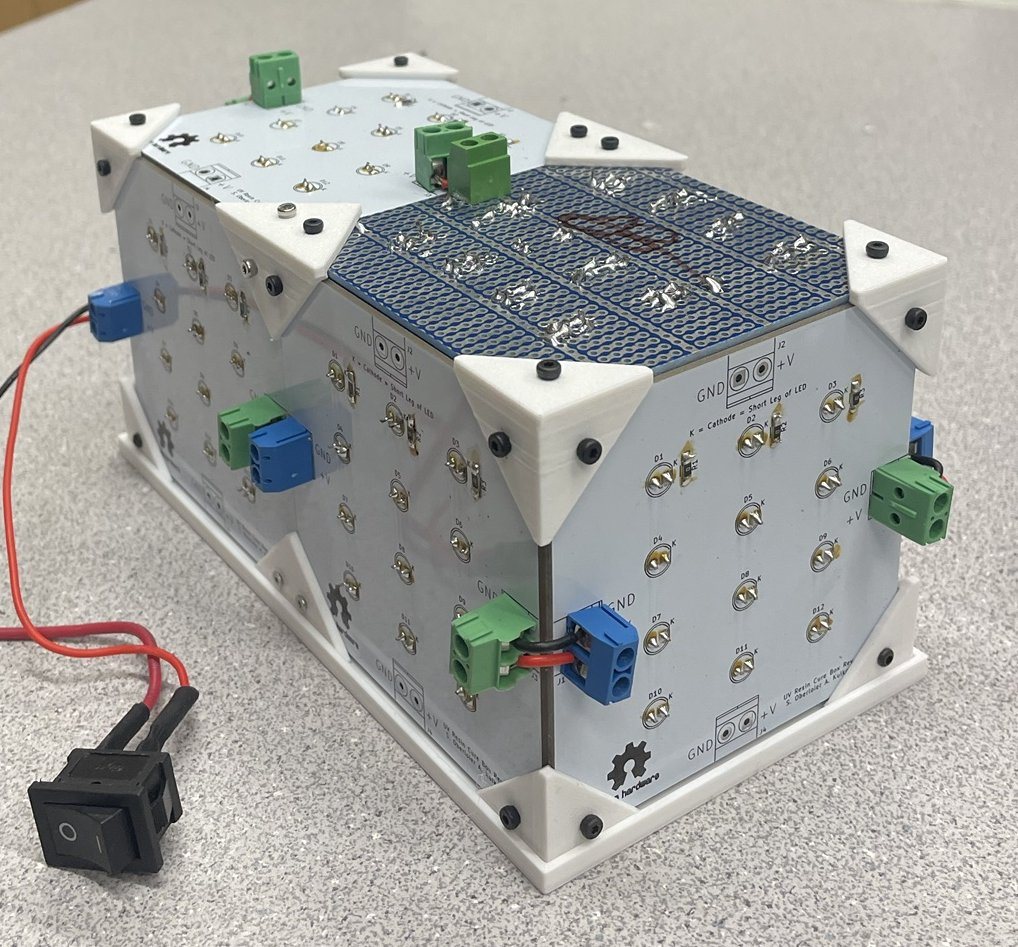
- The box is two 80 mm cubes end to end, 160 x 80 x 80 mm, from 8 boards: two on each long side, one on each end, and two on top as a lid that lifts off. It stands in a printed tray, with no board underneath.
- It takes 12 connectors and 32 M2 screws, one per connector plate: 4 at the top corners, 4 at the bottom corners, 2 along the top where the lid’s boards meet, and 2 where the boards meet at the bottom of each long side.
- The screws tap into holes in the printed connectors. In the first prints a few holes were loose and took nuts; panel-cube-joints now draws a round 1.7 mm pilot for them, which has not been test-printed yet.
- One lid board, damaged beyond repair, is replaced by a perfboard. The supply leads carry an on/off rocker switch.
Origin and licence
Section titled “Origin and licence”The design is from:
Gallup, N., Pringle, A. M., Oberloier, S., Tanikella, N. G., & Pearce, J. M. (2020). Parametric nasopharyngeal swab for sampling COVID-19 and other respiratory viruses: Open source design, SLA 3-D printing and UV curing system. HardwareX, 8, e00135. https://doi.org/10.1016/j.ohx.2020.e00135
Its files are also on the Open Science Framework, https://osf.io/z5jgu/.
The paper releases the design under the GNU General Public License v3.0 and the
CERN Open Hardware Licence v1.2. LICENSING.md says how they
apply here, and both texts are in LICENSES/.